
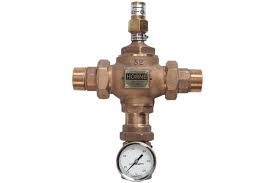
Horne Mixing Valve
A Horne mixing valve (often referred to as a Horne thermostatic valve) is an industry standard in industrial applications and large buildings where precise and reliable water temperature control is required. It is a mechanical, self-acting valve that mixes hot and cold water to achieve the desired outlet temperature.
Below is an overview of its operation and structure:
- Operating principle
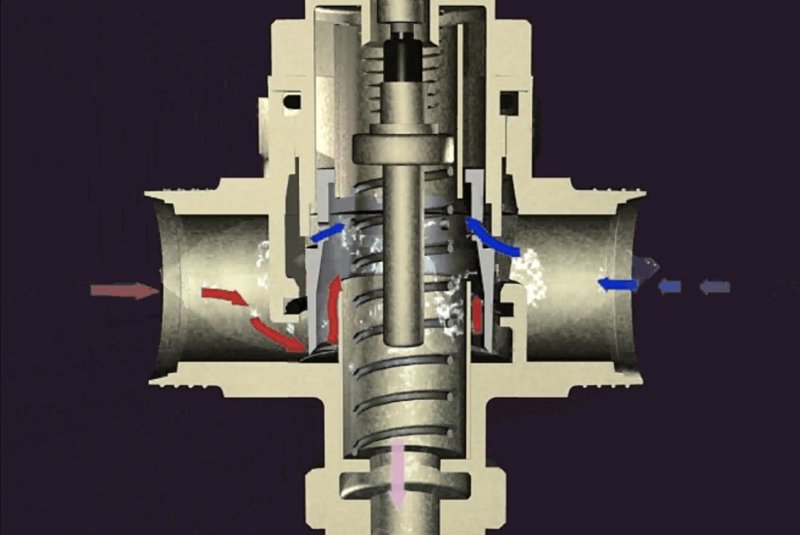
A Horne mixing valve operates with an internal thermostatic cartridge that reacts to changes in water temperature:
- Thermal expansion: As the temperature of the mixed water rises, the wax inside the cartridge expands and pushes the valve spindle.
- Regulation: The spindle moves the shuttle, reducing the hot water inlet and increasing the cold water inlet accordingly.
- Return spring: When the water cools, the wax contracts and a strong return spring pushes the mechanism back, increasing the proportion of hot water.
- Key features
Horne mixing valves stand out from many consumer products due to their durability and serviceability:
- Accuracy: They maintain a very stable water temperature even when inlet pressures or temperatures fluctuate.
- Safety (Legionella and scald protection): The valve allows water to be stored at high temperatures (above 50–55°C to prevent Legionella, and up to 65°C in critical locations), while reducing it to a safe level (e.g., 38–42°C) before distribution.
- Thermal shut-off: If the cold water supply fails completely, a high-quality mixing valve immediately shuts off the hot water to prevent scalding.
- Durable material: The body is typically made of gunmetal (bronze), which offers significantly better resistance to corrosion and scaling than brass.
- Applications
Horne mixing valves are particularly used in applications with high water demand or strict safety requirements:
- Hospitals and care homes (where scald protection is critical).
- Schools and swimming/sports facilities (large shower areas). A single mixing valve can supply dozens of showers.
- Industrial processes requiring consistent water temperature.
Horne mixing valves are available in sizes DN15–DN50 and for the following temperature ranges:
- – 15°C – 32°C
- – 32°C – 52°C
- – 45°C – 62°C
- – 58°C – 80°C
- Maintenance and installation
One of the major advantages of Horne valves is that maintenance can be carried out without removing the valve from the pipework. All internal components are replaceable by opening the valve cover.
Note: For proper operation, the valve typically requires check valves on both inlet pipes (hot and cold) to prevent pressure differences from causing reverse flow in the system.
Would you like more detailed technical data for a specific model (e.g., DN size or flow rates), or instructions for valve adjustment?